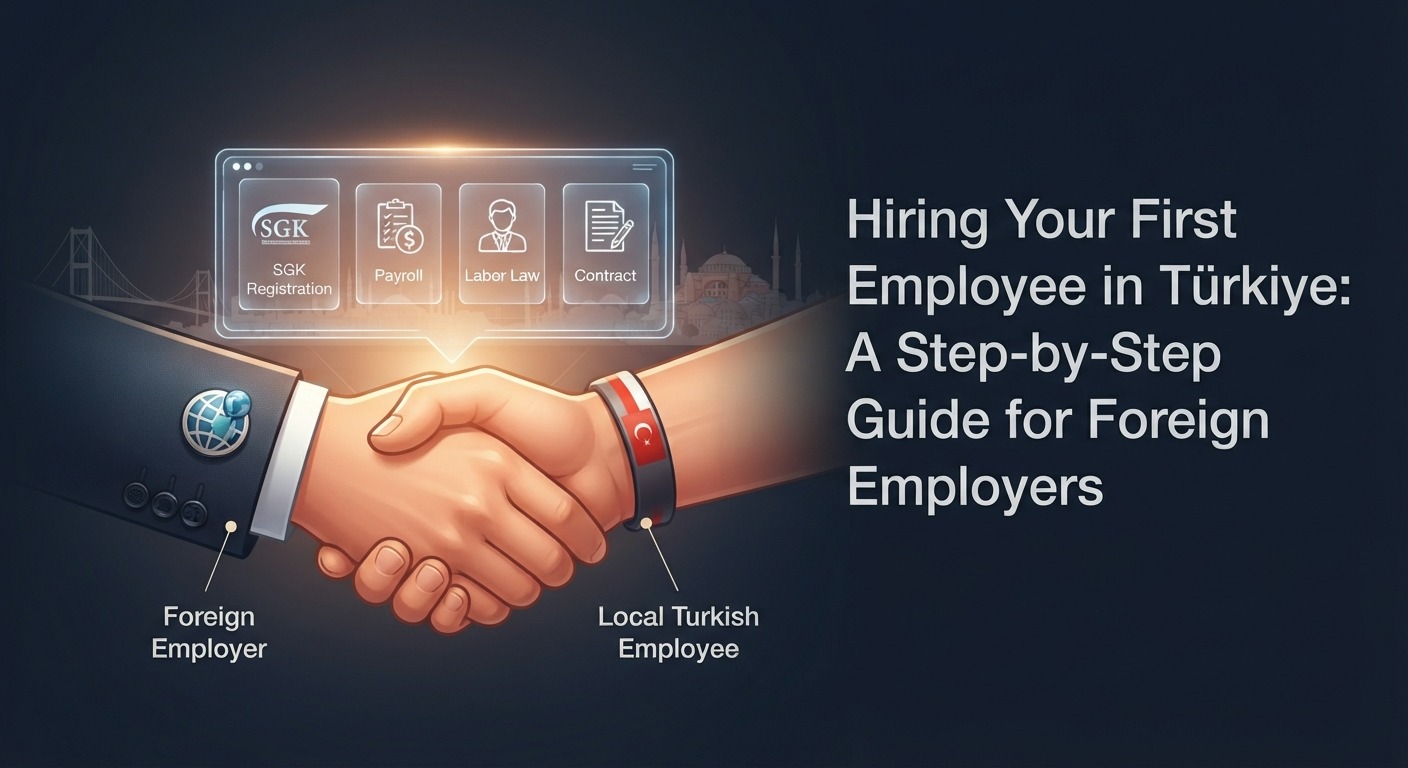
Expanding your business into Türkiye offers access to a dynamic market and a highly skilled workforce. However, for foreign companies, navigating the local labor laws, social security requirements, and administrative procedures can feel overwhelming.
Whether you are setting up a local entity or testing the market, here is a practical roadmap to hiring your very first employee in Türkiye smoothly and compliantly.
Step 1: Decide Your Employment Structure
Before making an offer, you need to determine how you will legally employ your team member in Türkiye:
- Setting Up a Local Entity (A.Ş. or Ltd. Şti.): If you plan long-term operations, establishing a Turkish subsidiary or branch allows you to employ staff directly through your own payroll.
- Employer of Record (EOR): If you want to hire quickly without establishing a local company immediately, an EOR acts as the legal employer on your behalf, handling local tax, payroll, and HR compliance.
Consultant's tip for first-time employers: If you are establishing a local entity for the first time, I strongly recommend outsourcing your payroll and SGK compliance processes initially. Outsourcing allows your management team to stay focused on core business objectives and market adaptation without getting bogged down in complex local administration. Once your operations stabilize and your local headcount reaches a scale where in-house management becomes cost-effective, you can smoothly transition payroll operations in-house.
Step 2: Understand the Employment Contract Requirements
Turkish Labor Law (Law No. 4857) strongly protects employee rights. Written employment contracts are legally required for fixed-term contracts or agreements lasting one year or longer.
Key clauses to include in your agreement:
- Trial Period: Standard probation is up to 2 months for individual employment contracts. (Collective bargaining agreements can extend this to 4 months, but for foreign employers hiring individual staff the standard cap is 2 months.)
- Working Hours: Maximum working hours are capped at 45 hours per week under Turkish Labor Law. Weekly hours can be set lower in the contract, but any work exceeding the agreed terms or 45 hours constitutes overtime.
- Salary Terms & Currency: Employment contracts and mandatory SGK filings are processed in Turkish Lira (TRY). Many foreign employers plan salaries as a net euro or dollar budget, but since 2018 Decree No. 32 on the Protection of the Value of the Turkish Currency does not allow wages between parties resident in Türkiye to be agreed in, or indexed to, a foreign currency. Limited exceptions exist, most notably for employees who are not Turkish citizens. For Turkish-citizen employees, agree the salary in TRY and confirm the details with your accountant or payroll advisor.
How it works in practice: Where a foreign-currency salary is permitted (for example, for a non-Turkish employee), on payment day the agreed net amount is converted to TRY using the applicable exchange rate, from which the gross salary, social security contributions, and taxes are calculated.
Outsourcing note: Navigating net-to-gross conversions and currency fluctuation adjustments requires precise accounting; this is typically handled seamlessly by local CPA firms or outsourced payroll partners.
Step 3: Registration with SGK (Social Security Institution)
Every employer in Türkiye must register with the Social Security Institution (SGK) before an employee starts working.
- Workplace Registration: The employer must open an SGK workplace account to obtain a unique workplace registration number.
- Employee Notification (İşe Giriş Bildirgesi): You must notify SGK of the new hire at least one day before their official start date. Failure to meet this deadline results in administrative financial penalties.
Step 4: Setting Up Monthly Payroll & Compliance
Once your employee starts, monthly operational obligations begin:
- Gross-to-Net Calculation: Understand social security contributions, income tax withholding, and stamp tax.
- Mandatory Health & Safety (İSG): Employers are required by law to provide workplace health and safety services, even for a single employee.
- Personal Data Protection (KVKK): Ensure you collect employee data in compliance with Turkish data protection laws.